Russia's impulse toward self-destruction
A Gentleman in MoscowRussia's impulse toward self-destruction is Mishka's name for a recurring contradiction in Russian history: a people capable of creating cities, churches, art, and poetry can also turn against those creations. He develops the idea over a conversation with the Count, moving from the burning of Moscow to paintings of fathers and sons, demolished churches, silenced poets, and livestock slaughtered rather than surrendered. What first appears to him as a source of shame becomes, through a dream of Vladimir Mayakovsky, a claim about the intensity of Russian belief in art and human life.
A Pattern, Not an Isolated Disaster
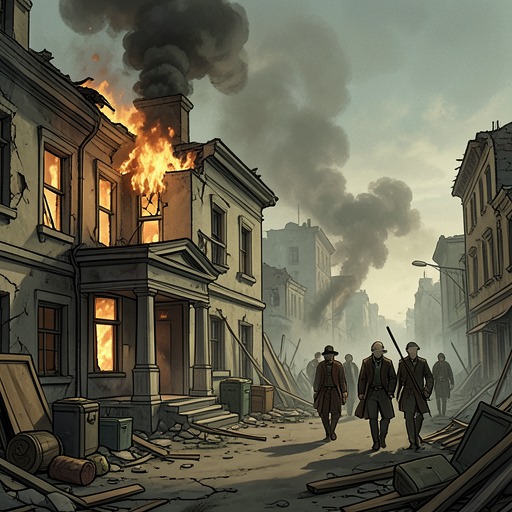
Mishka begins with the burning of Moscow in 1812. He asks the Count to imagine Napoleon being roused at two in the morning and leaving his newly made bedroom in the Kremlin to discover that citizens had set fire to the city he had claimed only hours earlier. The scene makes the destruction both a military-historical episode and a deliberate act by the people whose city it was. Mishka insists that this was not an exceptional occurrence but an instance of a recurring form: Russians, he argues, have repeatedly destroyed what they themselves created.
His distinction between a single event and a form of events gives the concept its reach. Moscow's burning is not merely an example to remember; it is a pattern through which Mishka interprets other acts of destruction. The claim is sweeping, but the speech grounds it in distinct objects and gestures rather than leaving it as an abstraction: a capital set alight, churches razed, statues toppled, names removed from streets, and animals killed by their owners.
Images of Creation Turned Against Itself
Mishka frames national identity through monumental painting. Where he names Delacroix's Liberty Leading the People, Rembrandt's Night Watch, and Washington Crossing the Delaware as defining images for other countries, he proposes two Russian paintings as a pair: Nikolai Ge's Peter the Great Interrogating Alexei and Ilya Repin's Ivan the Terrible and His Son. He describes both as scenes of a father confronting his eldest son, with suspicion and the threat of condemnation in the first, and fatal violence already completed in the second. The paired images make destruction intimate as well as national: the power that builds a state or a legacy appears alongside the power that turns against its own heir.
The paintings are not obscure examples in Mishka's account. He says they have been revered by the public, praised by critics, and sketched by students for decades. Their place in public culture makes their subject matter harder to dismiss as an isolated act of cruelty. They stand as celebrated pictures of creation and inheritance shadowed by the prospect, or fact, of their destruction. Mishka's national portrait is therefore built from a disturbing doubleness: Russian culture preserves images that expose violence within the family and within authority.
He extends the same doubleness from pictures to public space and literature. Churches celebrated for their distinctive beauty, bright spires, and improbable cupolas are, he says, demolished one by one. Statues of earlier heroes are toppled, and their names are stripped from streets as if their lives had never existed. Poets are silenced, or left to silence themselves. Each instance involves not only destruction but the undoing of memory: buildings disappear, public honor is withdrawn, and names are removed from the everyday landscape.
Collectivization and the Cost of Refusal
Mishka gives his argument a numerical, material example from the announcement of mandatory farm collectivization in 1930. He says that half the peasants slaughtered their own livestock rather than give the animals to the cooperatives, leaving fourteen million head of cattle for buzzards and flies. The number makes the scale of the destruction difficult to absorb, while the cause matters as much as the result: the livestock are killed in refusal of their transfer. The episode is not simply loss imposed from outside; in Mishka's account, people destroy property they possess rather than see it taken into a new arrangement.
As he speaks, Mishka lifts a fork with a piece of untouched veal on it, then gently returns the meat to its plate as if showing respect. The gesture briefly concentrates the argument in an ordinary object. The discussion concerns millions of animals, but the fork holds a single piece of meat; Mishka's care in setting it back contrasts with the vast slaughter he has just described. That contrast does not resolve the contradiction. It makes the cost visible at human scale.
From Shame to a Claim About Belief
Mishka acknowledges that the pattern troubles him. He imagines how shocking it must seem to foreigners that Russians would destroy artworks, ravage cities, and kill their own children, and says that the thought once unsettled him enough to keep him awake. His first response is not triumph but pain: he fears that Russian self-destruction will be read as proof of brutish indifference, as though nothing were sacred. The concern makes his eventual interpretation a reversal rather than a simple celebration of violence.
He locates that reversal in a dream. Vladimir Mayakovsky appears to him and recites unfamiliar, haunting verse about birch bark shining in winter sun. Then Mayakovsky loads his revolver with an exclamation point and shoots himself in the chest. Mishka presents the dream as the moment when the meaning of self-destruction changed for him: he no longer considered it an abomination to be ashamed of, but a strength. His explanation is not that Russians care less than the British, French, or Italians; it is the opposite. He argues that they are prepared to destroy what they have created because they believe intensely in the power of the picture, the poem, the prayer, or the person.
That interpretation does not make the destruction harmless. Rather, Mishka makes belief and destruction coexist: the willingness to sacrifice a creation becomes, in his account, evidence of how powerfully its value is felt. He ends with the prediction, “We have not burned Moscow to the ground for the last time.” The line carries the argument forward from 1812 as a warning of recurrence, not as the promise of a particular future event.
The Argument Heard by the Count
Mishka delivers his ideas with fevered intensity, seeming at moments to be making his case to himself. When he sees the distress on the Count's face, however, he laughs warmly and squeezes his old friend's forearm. He recognizes that his talk of revolvers has unsettled the Count and reassures him that he still has something to attend to: a library visit for a project. The personal exchange places a human bond beside Mishka's account of national violence, without making the argument disappear.
Later, the Count relays Mishka's views to Osip, including the burning of Moscow, the toppled statues, silenced poets, and slaughtered cattle. Osip listens attentively and asks whether the Count is troubled because Mishka's assertion is shocking, because it offends his sensibilities, or because he fears for Mishka's state of mind. He also distinguishes the possible truth of Mishka's opinions from the soundness of his sentiments. The distinction leaves the concept open to examination: Mishka's examples and pattern may command attention even if his conversion of destruction into national strength remains unsettling. In that gap between an intelligible diagnosis and a troubling consolation, the idea retains its force.